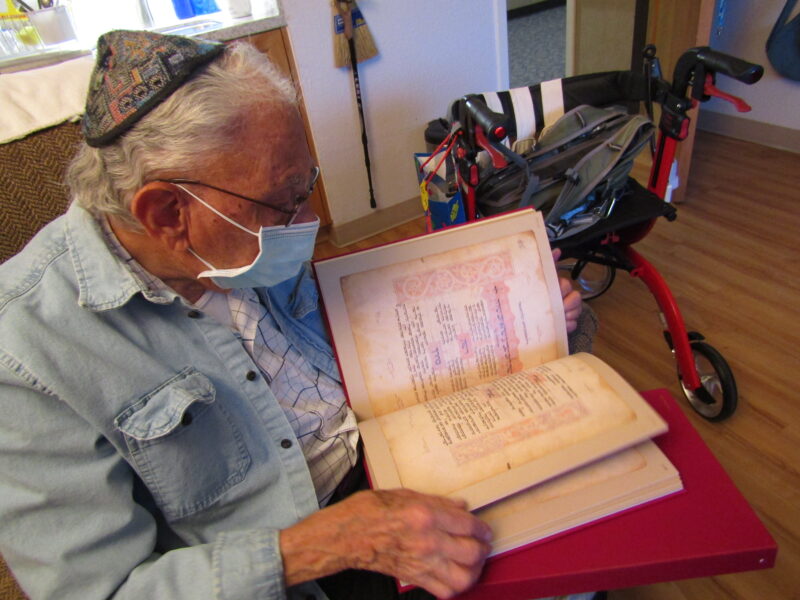

Rabbi David Davis likes to say he walked the line and had to make a choice. Today a professor emeritus and chairman of the board of the Osher Lifelong Learning Institute at Arizona State University, he said the desire for his own congregation eventually evolved into a commitment to full-time academia. Much happened along the way. President Lyndon Johnson recognized his contribution to civil rights with an invitation to the signing the Civil Rights Act of 1964. Jesuit Fr. John Lo Sciavo of the University of San Francisco called him a “one-man ecumenical movement,” and in 1990, Hebrew Union College awarded him an Honorary Doctor of Divinity.
“As often is the case, a rabbi and teacher of mine was influential in sug- gesting that I might be a good candidate,” Davis said. “You can do a lot of things – preach, teach, counsel and establish interfaith relationships in the community. The clergy offered me the opportunity to speak and exchange ideas with people of all traditions.” After graduating Hebrew Union College, he found work in a Massachusetts congregation and began teaching part- time at Clark University. Then an opening came up at the Catholic University of San Francisco. “That changed my life,” he said. “I was teaching theology as well as marriage and therapy. I’m a licensed marriage and fam- ily therapist as well.” One of his favorite courses was titled “Jesus the Jew,” where he swapped roles with a non-Jewish professor – “He taught Jesus from a Jewish perspective, I from a Christian.” The University of San Francisco rewarded Davis with the first chair in Jewish Studies at a Catholic university in the United States.
After 20 years at the University of San Francisco and five at Vanderbilt University in Tennessee, Davis and his wife built a home in Arizona and planned to retire. That didn’t last long. Soon he was teach- ing at Arizona State University’s Honors College and thIn 2001 the Bernard Osher Founda- tion began awarding grants for college and university non-credit programs aimed at adults aged 50 and up. Today 116 programs across the country provide short classes, lectures and workshops to mature adults. At Arizona State, courses include “Introduction to Travel Writing,” “From Quarks to Cosmos” and “The Bible: Is itStill Relevant in the 21st Century?” “The Osher program is named in honor of Bernard Osher,” Davis said. “He is a philanthropist and a good friend of mine. There is something satisfying about teaching more mature students. It’s just as important to keep our minds sharp as our bodies, and there has been an explosion of course opportunities across the country for senior citizens. When Bernie Osher came up with the concept of lifelong learning, he believed it was a lifelong experience, as do I.”
Spring classes at OLLI begin in February.
For information about registration and upcoming classes, call 602-543-6440 or visit lifelonglearning.asu.edu.