

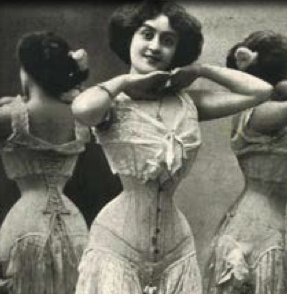
“You can always spy the wealthy ladies. They have the tiny middles, walk as if on tip toes and are always breathless to see me.” – Eadweard Muybridge, a Victorian era photographer. The wealthy ladies that Mr. Muy- bridge was speaking about were the society women of the 1880s, and the appearance he was describing was caused by the fashion of the day, the corset. The wealthy woman of the Victorian era was expected to have a waist of not more than 20 inches on her wedding day. The bride’s social status was represented by the woman’s figure, and so to attain the desired “hourglass” form, girls as young as 4 years old were fitted into undergarments called Ferris, tiny corsets that when laced up the back would over the years conform bone growth to the willowy shape so desired.'
Adult society women of the period wore on an average more than 20 pounds of clothing, and to maintain their waists, seldom consumed over 800 calories each day. Their undergarments were designed to constrict. The corset of the 1880s was made from seven to 13
individual pieces. The gusseted, rein- forced-stitched corset made from strong twill cotton used up to 16 vertical rows of whalebone shaped to constrict the natural body form. The corset hooked with steel hooks at the front front and was then laced up the back with rawhide and ribbon laces. Women of lesser wealth would wear the same design of gar- ment, but with wooden stays replacing the expensive whalebone. Because the dress bodices of the time were lengthening, the actual dress bodice was also boned in sections to give additional contour to the body. This lengthened bodice made it difficult to breathe and to take a step longer than six inches, making it appear that the wearer was walking on tip toes and constantly short of breath. Maternity did not release a woman from the corset. Corsets worn during pregnancy were laced up on each side of the garment and adjusted as the pregnancy progressed.
Wearing the corset required the assistance of another person: a personal maid or a willing spouse who would pull and tug at the lacing, reducing the normal circumference of the waist from 25 or 27 inches to the desired 20 inches. The corset was functional in that it prevented the wearer from performing the everyday household chores; thus the status symbol of a tiny waist equated to wealth. As uncomfortable as the corset was to wear, there were many other “proper” undergarments expected to be worn. The well- dressed woman would begin her dressing ritual with a simple sheath gown of cotton or linen that was slipped over the head and over which the corset would be placed; then came a lightweight full slip or corset cover, a petticoat and open-crotch pantaloons. The full wire-circle bustle of the Civil War era gave way to a wire or horsehair bustle that tied around the waist and sat astride the woman’s hips; then at least one, and as many as four, additional petticoats were worn. Finally knitted stockings were worn with high-top, laced boots.
Women of poorer classes, especially of the rural population, who were required to work long hours wore the corset only for special occasions and opted for a chemise-type undergarment with or without the pantaloons and bustle.
After 1900 the wasp waist became less acute and corsets be- came straighter. The corset of 1900 achieved a long, slim silhou- ette with a monobossom or “pigeon front” appearance. The corset started just above the waist and fitted well down the thighs. They often had elastic gusset inserts that were supposed to increase the comfort level. As ever, fashion won out and to match the new longer slimmer dress styles of the early 1900s, corsets increased in length and almost reached the knees, making sitting down quite difficult.
Corset ads became the centerfolds of the Victorian era, and newspapers were careful not to publish risqué drawings in fear of losing ad revenues from more conservative advertisers. An 1890s window display of women’s undergarments in the Levy depart- ment store in Tucson made front page news in the Citizen news- paper, and demonstrations of protest by local residents followed.
World War I put women to work, and the subsequent blending of society made the corset and the heavy, cumbersome undergar- ments obsolete. For the first time since the corset was invented in the 1400s, women all over the world could easily take a deep breath, and forcing women’s bodies into unnatural positions to gain social status ended. ␣
Eileen R. Warshaw, Ph.D., is the executive director of the Jewish History Museum in Tucson.