
Free Money: Sound too good to be true? That’s exactly what those in need from the Jewish community can count on through the Jewish Free Loan Association in the Valley and the Hebrew Free Loan Association in Tucson.
Need some unexpected dental work? Your air-conditioning unit suddenly gave out? Just when you were getting your finances under control! And how can you possibly handle the extra costs of your son or daughter going to college? Even the best of planners can easily find themselves in a financial bind, particularly in today’s unpredictable economy. In the Phoenix area, interest-free loans ranging from an emergency $500 up to $20,000 toward a four-year college education, and lots of options in between, are available through the local office of the Jewish Free Loan. “We like to say we’re here for life’s ups and downs, and everything in between,” states Ellen Sacks, director of programs and public relations for JFL. As of 1997 the Phoenix organization loans only to those who are Jewish in order to help meet the needs of the specific community. The Tucson office will loan to anyone with the proper criteria of residency and co-signers. A typical loan ranges from $1,200 for an individual to $2,400 for couples, though they have loaned more when warranted.
“I’m afraid we’re a well-kept secret here,” admits Phil Bregman, president of the Hebrew Free Loan in Tucson. “We are constantly trying to get the word out to let people know we’re here to help.”
More than 40 Jewish Free Loan organizations exist through- out the world – in both North and South America, Australia, South Africa and Israel. Some have different names and each has its own independent requirements, but they are all set up with the same directive in mind: to follow the biblical passage, Exodus 22:24: “Thou shall not exact interest from the needy among you.” They all further a belief in gemilut chasadim, acts of loving kind- ness. In this case the term applies to helping people to become or remain self-supporting, self-respecting members of their community. The Phoenix organization be-
gan in the 1940s and has given out thousands of loans over the decades to individuals and families in need. “We can tailor the payments to the individual,” explains Sacks. “We understand that some people may need a few extra months, depending on the situation.”
There are a number of Named Donor Funds available, including the Fran and Al Sachs Jewish Adoption Fund, which was set up to support the adoption process for parents who intend to raise a Jewish child; three business development funds to help with job training, or establishing or expanding a small business; a number of educational funds, which can be used for Jewish camps as well as all levels of education; medical/emergency funds; personal crisis funds; and even designated burial funds.
EDUCATION FUND DEADLINE – MAy 15, 2013
Jewish residents of Arizona enrolled in or starting their studies in the fall of 2013 need to submit their information and application to JFL by May 15 if they want to qualify for a loan. Individuals can qualify for up to $5,000 per year for four years. Interest-free education loans can be used to attend community college and technical or vocational school programs as well as universities. Thirty-six JFL educational loans are currently helping students not only at Arizona State University, University of Arizona and Northern Arizona University, but also at Ben-Gurion University in Israel and schools such as Stanford, New York University, Em- ory and the University of Southern California. Qualifications and more information can be found at jewishfreeloan.org.
This year JFL received funds from the Jewish Community Foundation and the Jewish Community Association, but most funding for the organizations in both communities comes from individuals.
Barbara Mehl-Goldman had a very personal reason for start- ing her fund at the Jewish Free Loan. As a youngster in Chicago, she and her sister spent several years in an orphanage while her family sorted out various problems. The costs were absorbed by the JPI, the Jewish People’s Institute. Even after she and her sister were reunited with their family, the JPI ensured that they could go to Jewish summer camps. The concept of Jews helping Jews resonated with Barbara and became implanted in her.
When her first husband, Harold Mehl, was in hospice, he told Barbara he wanted her to start a fund to stand as a legacy as well as a thank you for all the support she had received over the years. He chose to donate his body to science through Science Care, and asked Barbara to take the money that would have been spent on a funeral to start funds at JFL, both in Israel and in Phoenix, since they had family in both locales. The Mehl Fund in Israel recently helped a couple adopt seven children from one family after their birth parents were killed in an attack. While the local fund is generally designated for higher education, Barbara recently received a call from JFL asking if she would be willing to have her funds used to help a local family adopt. Barbara has an adopted child herself, so there was no question in her mind. “Absolutely!” she replied to the request.
Because JFL has a 98% loan repayment rate, donors over again.can be assured that their funds will be used over and “We think of it as the best kind of recycling there can be!” Sacks says with a smile. “With the repayments coming in, we can ensure that JFL will be here to help. Of course the more funds we have, the more people we can assist. We know there are still many unmet needs in our community.” Both JFL and HFLA in Tucson are eligible to receive dona- tions as part of the Arizona Working Poor Tax Credit. Donations made this way can reduce Arizona state tax liability up to $200 per person or $400 per couple.
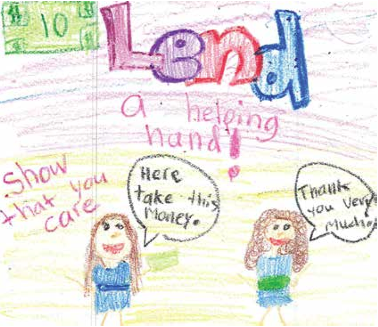
Reaching out to children, last year JFL held an art contest among elementary school students. The winning drawings now adorn the tzedakah boxes distributed by JFL. This year JFL hosted an essay contest, with the topics being “What does tzedakah look like to you?” and “Why is a hand-up better than a hand-out?” “We do lots of collaborating to help get the word out about what we do,” Sacks explains. “We work with the B’nai Tzedek program that gives hands-on experience to teen philanthropists, for example. Once young people know how good it feels to be able to help others, they are more likely to continue to do so. We also work closely with Jewish Family and Children’s Services, particularly to provide economic crisis loans for basic needs.”