
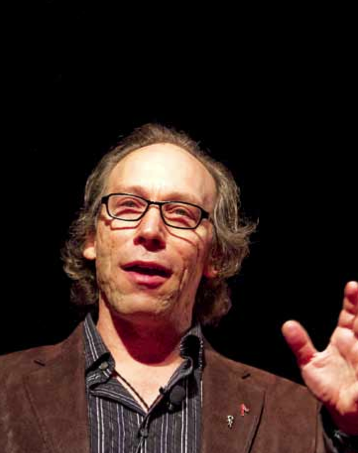
Professor Lawrence Krauss has a lot of titles. There’s the obvious one: professor, as he is a professor at Arizona State University in Tempe. There’s also foundation professor, in that he’s the foundation professor in the School of Earth and Space Exploration, also at ASU. Then there’s director of the Origins Project at ASU. Plus a prolific author who has written more than 300 scientific publi- cations and that about half a dozen books have his name on the spine. We’re sure the person who makes his business cards is quite busy.
But when referring to the man, most of the time it’s as a theoretical physicist, with a focus on theoretical particle astrophysics and cosmology, including things like dark matter and black holes. He’s appeared on television numerous times, spoken in front of mammoth crowds and carved out a niche for himself as a celebrity scientist of sorts, all because of his unique take on the universe and its creation. He covers this theory in his latest book, A Universe from Nothing. “I wanted to tap into this age-old question: why is it something rather than nothing?” he says. “Because, of course, it is the basis of a lot of religion and philosophy, but more importantly the developments in science and cosmology over the last 30 years has changed our picture tremendously and made us realize how much more plausible it is that the universe actually could have come literally from nothing by just the laws of physics, without any supernatural intervention.”
This would be a fairly controversial position to stand on if Krauss were a religious man, but he’s not. In fact, it’s quite the opposite. “I think the point for me is that, for many of my Jewish colleagues, Judaism is a cultural thing more than a religious thing – and I can understand that. But frankly, for me, as a hard-nosed scientist, which is what I am, I find the cultural basis of Judaism – being based in the ancient scriptural tradition – as being ridiculous.” Though that may sound harsh, it’s the perspective of a man of science, and really shouldn’t come as a shock. Has being Jewish had an impact on his life, though? “Well, I don’t know. Culturally, [Judaism] may have had an impact in the sense that apparently Jewish families value learning – so I’ve been told. And my, it certainly was true in my case,” he explains. “But frankly, other than that, I don’t think it’s had any impact whatsoever.”
Instead, Krauss has devoted his life to science and the further study of the universe we live in. He wants to debunk bad science, misinformation and special interest promotions that flood the media today, and talk about the hard truths he’s learned and discovered in his time on the earth. “One of the reasons I like to teach people about science is not the facts so much, but the tools that allow you to distinguish sense from nonsense,” he says. “That’s what science is all about – a process.”
This has led to his success in the field, and he’s become a bit of a celebrity scientist. One look at his website shows the multiple speaking engagements he has booked throughout the year, and they’re not just in Tempe. This month he’ll be speaking at Williams College in Williamstown, MA, and in March he’ll be in Oxford and London participating in various events. If he’s not working or teaching, he’s taking his classroom to the world.
How did Krauss get so interested in science? Well, like the story of many Jewish kids growing up, it starts with his mother. “Quite simply, my mother wanted me to be a doctor,” Krauss says. “I got interested in medicine, I suppose, and then I learned that doctors for the most part were scientists, but then I was hooked on science and I read books.”He started taking in the works of Asimov and Einstein, and soon his mind opened up to a whole other world. The positive experience of reading books from some of the greatest minds in recent history led him down the path to what he does today. “That’s one of the reasons why I author books now, to sort of return the favor,” he says. “One of the most gratifying things that happens to me is when some young person, or maybe not so young anymore, writes to me and says it was because of your book that I became a scientist. I think that’s a wonderful, wonderful thing.”
In his time in the field, he’s also watched scientists go from a nerdy profession that wasn’t quite as popular to one where physicists have TV shows and heavily retweeted Twitter accounts. In an interesting side note, a quote by Krauss was tweeted by Miley Cyrus in March 2012. It became a controversy in the Christian community, as Krauss’ quote ended with, “So forget Jesus. Stars died so you can live.” It’s almost as if science has become hip. “And, of course, I try to contribute to that by being a public figure, to being as cool as I can be,” Krauss says with a laugh.
But there is a serious side to being cool, and that’s getting the message out any way you can. “I think you’re finding more interest among scientists in general in trying to communicate to the public, partly because I think many scientists have realized that we need to in order to continue to have public support for the kind of science we want to do because it’s not cheap,” he says. “And it’s more than just self-interest – the public has a right to know. The public is paying for this, and a lot of the ballsy issues that they’re going to have to vote on are scientific, and they have a right to get to the best possible information.”This is why he uses every medium he can to get his message across, from books to the web, social media, and, of course, the classroom.
He’ll use any method he can to open the doors to science, too. One of his first books – and the one often brought up in conversa- tion – was The Physics of Star Trek, originally published in 1995. The concept of the book began as a joke between Krauss and his publisher, based on a conversation he had with his daughter, who was a Trekkie. He and his publisher laughed about how it should become the topic of his next book. “But then, on the train home I started to think, ‘You know, how would I make a transporter?’ And it began to fascinate me. I realized all the neat physics you’d have to think about if you wanted to make a transporter and I thought, ‘Wow, that could be interesting.’” Of course, ticking off a powerful legion of fans could also be a real downer, so he didn’t want to become a guy poking fun at someone else’s obsession. “I spent three months between midnight and 5 o’clock in the morning watching every episode of ‘Star Trek.’ And then, once I felt sufficiently conversant, I started to think about how I’m going to write it.”The result was a book that talked about what was and wasn’t possible between the “Star Trek” universe and our own, but it all was an elaborate ruse. “I really wanted to use ‘Star Trek’ as a hook to seduce people into learning about the real universe,” he says. And it worked.
Ultimately, Krauss’ mission is to expose as many people as possible to the world of science, through whatever means he can. By talking about it in real terms that people can understand, he accomplishes that goal. “Too often, scientists talk like science was done 200 years ago by dead white men and that was it,” Krauss says. “I try to show kids that the stuff they’re learning is actually relevant today. And I think that’s very important as well.”
What does the future hold for Krauss and his mission? He’s been involved in a movie called “Beyond Believers” that features Richard Dawkins discussing science and faith around the world. It also includes several celebrities such as Woody Allen and Cameron Diaz. When asked about the film title, Krauss says, “It’s perfect for your magazine.”